
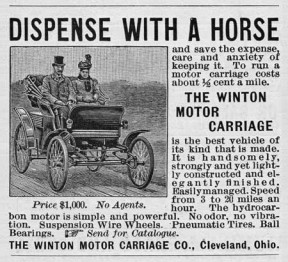
The inestimable Maria Popova (@brainpicker) drew my attention to the very first car advert in a weekly publication, first printed in 1898, through a tweet, posted last week. It was printed in Scientific American. The headline jumped out at me: ‘Dispense With A Horse’. Seems like an odd way to sell a car, right?
It is rare to see something presented in terms of what it’s not. However, this new Winton Motor Carriage is evidently not a horse; it is to replace a horse. In fact, it is arranged so as to replace the horse, the horse-drawn carriage, and the up-keep of the horse. One can be sure there are no horse related options with the Winton Motor Carriage. This is all true, and relevant to the decision making process.
But it still ‘jars’. It seems – surprising saying it’s not a horse. Why does it seem so odd?
The true opportunity cost is broader than the category (Honda versus Toyota) and has effects extending into the future. Ariely says that consumers in the Toyota dealership were not saying: ‘In the future, I will have to give up two weeks of vacation and 70 lattes’ and 1,700 books’ (or– I would add – private schooling for their child for a term, or a family holiday, etc) even though they would make more informed choices by considering this. (Not different choices necessarily, but more informed choices certainly.)
In this sense, the car advert from 1898 is correct in presenting the true opportunity cost of owning the Winston car versus a horse and carriage. But it’s clear we don’t naturally think that way. Why?
Primarily, we rarely think outside of a category because it’s hard work. Imagine an all-expenses weekend trip to Rome, played against an all-expenses weekend trip to Paris; They are different enough to present a challenging comparison. But with an additional ‘decoy choice’ of an all-expenses weekend trip to Paris excluding breakfasts, a closely related pair is created on the Paris side.
Now, the choice between the inferior and superior Paris options requires less cognitive load than either Paris options compared with Rome. Essentially, you are choosing only between breakfast and no breakfast. Because of this, the superior Paris option (all-expenses weekend including breakfast) usually wins in this scenario because it is the best choice of a dominant related pair. (Equally, you could adjust for Rome instead of Paris and create the opposite related dominant related pair.)
The ability of differences to be more closely examined with related pairs is described by the cost-of-thinking approach.” . . . it is clear we prefer economy of thought.” It states that decisions between closely related pairs (Paris with/without breakfast) are preferred because they charge a much lower cognitive ‘cost’ to work out than decisions where pairs aren’t related (Paris/Rome).
Indeed, one could easy switch Paris and Rome with the Winton hydro-carbon Motor Carriage, and a horse. Create a pair (dominant or related) with the Winton – another motor carriage with one inferior/superior function – and you make horse the outlying ‘Rome’.
However so presented, it is clear we prefer economy of thought.
We may also rarely think outside of a category because we are trying to minimize regret. In this case, ‘regret’ is defined as the ” . . . a choice from . . . the middle . . . insulate[s you] from maximum regret.”distance between the selection made from the choice available and the perfect choice (for you). An outlier (because it is a new category ‘on the block’), such as a motor carriage has lots of potential regret when the main action is in the ‘busy’ (and established) category of horse and carriage. If you make a choice from somewhere around the middle of the action you insulate yourself from maximum regret.
The revelation is that the surprise (salience) of seeing a car/horse comparison is born of unfamiliarity, and this unfamiliarity is a condition of our cognitive preference (handicap?) for economy of thought. It’s all ‘oranges and lemons’. This leads us to two one-line conclusions:
- If you’re making a selection think outside of the immediate category about the true cost
- If you’re selling a product or service find a comparison that pits one part of your product with a similar competitor in order to reduce cognitive choice load, and to minimise purchase regret
(Or you could try and find a faster horse.)
“This advertisement for the Winton motor carriage – the one often identified as the first American automobile advertisement – appeared on page 80 of the July 30, 1898 issue of Scientific American magazine, a nationally-distributed weekly for readers interested in reading about the latest innovations in science, industry and transportation. Winton’s gasoline-powered vehicle had four pneumatic tires and a “hydrocarbon motor.” The Winton Company advertised weekly in this magazine from July through December 1898 and into 1899. The illustration remained the same throughout 1898, although the ad’s title changed from week to week, usually repeating a second time. The title of the first ad, “Dispense with a Horse,” was repeated again August 13. The Winton Company of Cleveland, Ohio made and sold tens of thousands of vehicles from 1896 to 1924.” From the Henry Ford Museum

For more on this speak with us, or have a look at our capabilities
Also, as co-founders and supporters of the London Behavioural Economics Network, join the Meetup group and Facebook group for more details and events
Related Posts



Reading ease is not as easy as all that – comprehension shows the way
It's easy to make text readable, right?…

The ‘Hollywood hello’ – and the importance of context when communicating
When communicating we all like to be as…
very interesting, i like it very much. Thanks and I visit again your site in future to see more.