

Attention, Interest, Desire, Action. The AIDA model. Been around forever. Since 1925 in fact. And it works. Well, half of it works. And the half that works only works for product or lifestyles that speak to our selfish desires. Nothing wrong with that other than it’s an incomplete approach when making sustainability communication.
Speaking to our selfish desires is the reason car advertising works much better than anti-speeding messages. Let’s take this example further: The first is trying to create the desire for speed, freedom, style, conspicuous consumption; The second, trying to create desire for restraint, consideration, injunction, regulation, and conspicuous conformity.
Ewwww. The second approach is wrong – like having a party clown host a funeral.
 of changing speeding behaviour, which takes us to the glamourous Lanarkshire Council (UK) where they have speed signs that show drivers their speed, and then a ‘smiley face’ if they’re below the limit, or a ‘sad face’ if they’re above it.
The results?
- – the number of people exceeding the speed limit has fallen by 53%
- – Average speed reduction of 2.5mph at these locations
- – Maximum reduction 14mph
- – Cost perhaps 98% less to operate annually than a speed camera
A basic bit of social norms thrown in would change the approach completely – like Chief Iron Eyes Cody…
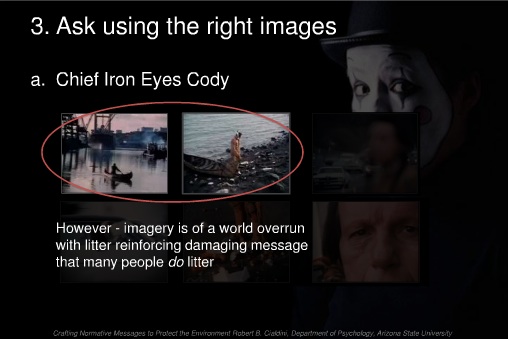
What you need to do is create the ‘norm’ that lots of people are already walking, and cars are the ludicrous alternative: a single car trying to squeeze last a bunch of carefee people walking down a lane from a country pub; a single car edging through a crowd in a shopping area, etc.
And you’d want to focus the message (you could still use TV ads) in locations where walking or cycling is a do-able alternative. Anything else would be a waste.
“…forget about all the detailed ‘bikeability indexes’—just measure the proportion of cyclists who are female” Jan Garrard, Senior lecturer at Deakin University in Melbourne, Australia.
Women are considered an ‘indicator species’ because:
-
- – They are more risk-averse than men
Do most of the childcare
- – Do most of the household shopping
Bike routes that are organized around practical urban destinations are highly likely to be successful – and consistently so. [slideshare slideshow: As soon as incentive programs are discontinued behaviour tends to flop back]
Creating Attention, Interest, Desire, and Action works perfectly well except when trying to create desire for restraint. Appealing to people’s greater good invariably falls on deaf ears. In those instances social psychology is the way to create desire where there is none, or indeed, create desire without anyone knowing that you did.

For more on this speak with us, or have a look at our capabilities
Also, as co-founders and supporters of the London Behavioural Economics Network, join the Meetup group and Facebook group for more details and events
Related Posts



Reading ease is not as easy as all that – comprehension shows the way
It's easy to make text readable, right?…

The ‘Hollywood hello’ – and the importance of context when communicating
When communicating we all like to be as…
Very interesting work you're doing on this. And it makes so much sense that guilt-tripping and negativity don't work. Moving towards (changing) social norms makes so much more sense. And of course that we're much more likely to move towards something that's somehow pitched as something we WANT. Thanks for the post, and I look forward to more on this.
The book “Made to Stick” by the Heath brothers has some really good examples of getting a message across when the desired behavior change would be seen as restraint. The “Don’t Mess With Texas” anti-littering campaign used celebrities who showed that they cared about Texas and put litter in trash cans. The message was that if you wanted to be a true Texan you wouldn’t litter. In a way they’re using desire to be cool rather than desire to be neat, but it’s still desire and it drove restraint. Littering was greatly reduced as a result of that campaign. There are other great examples in the book.
Yes you're right – Don't Mess with Texas is a great example. I've use it a few times in these presentations (you might like the rest of the presentations too). The first one's a bit more structured.
http://www.slideshare.net/oliverpayne/how-do-you-…
http://www.slideshare.net/oliverpayne/effective-c…
I shall look up Made to Stick – I wasn't aware of it, Ta http://www.amazon.co.uk/Made-Stick-Ideas-Others-U…
[…] recently discussed a similar situation where testing the infrastructural success of cycle routes was best achieved by using women as the ‘indicator species’. It’s clear that […]
[…] way to make it seem like an outsiders’ activity) that delivers information which (massively incorrectly) appeals to cognitive reason, and […]
thanks
to complete a website and working on design is not sufficient, we must think about the business and hire any professional who can give us an efficient and well designed logo for our business or website. don't forget a logo represent the business and service also.